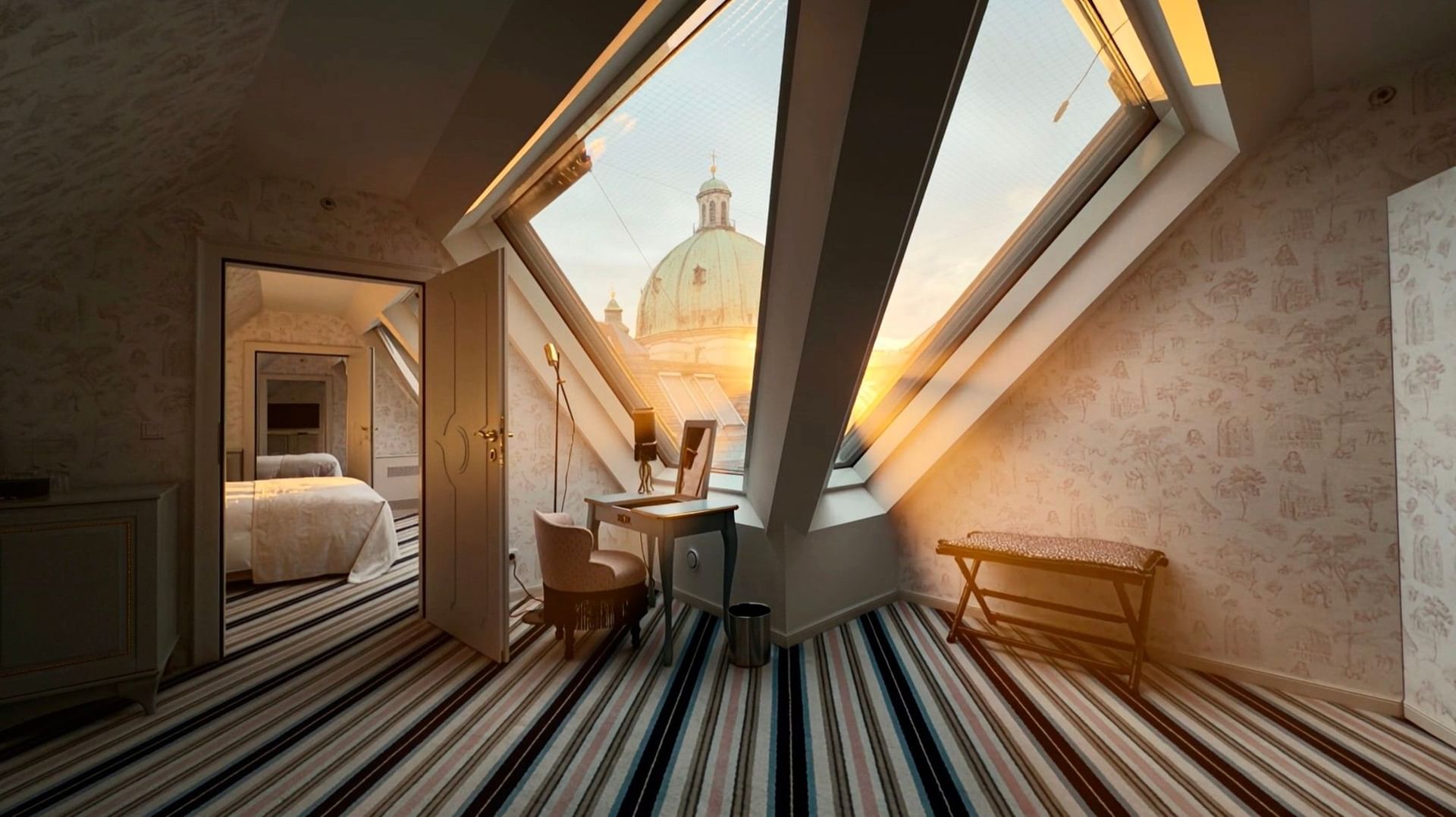
Blick aus einem Zimmer des THE LEO GRAND auf die Kuppellandschaft des ersten Wiener Bezirks im Morgengrauen

A Peace Treaty
Written in Wallpaper.

The story of an emperor, a banker, and the house that made peace where empires couldn't.

History, lovingly rewritten.

The Leo Grand ist nach Kaiser Leopold I. (1640–1705) benannt — einer der komplexesten und am meisten unterschätzten Figuren des Barockzeitalters. Er war vierzehn Jahre alt, als er unerwartet den Thron erbte. Fromm, musikalisch, tief verliebt in seine Frauen, und chronisch überfordert mit dem Staatshaushalt. Seine Regentschaft wurde von zwei großen Rivalen geprägt: Ludwig XIV. von Frankreich im Westen — unerbittlich brillant und unerbittlich kostspielig — und dem Osmanischen Reich im Osten, das 1683 vor den Toren Wiens stand.

Dieses Haus erzählt die Geschichte, wie diese Rivalitäten endeten — nicht durch Eroberung, sondern durch Versöhnung. Am Bauernmarkt 1 sitzen Ludwig XIV., Leopold I. und der Sultan am gleichen Tisch — als Zivilisationen im Dialog, nicht im Konflikt. Der Morgenkaffee — so die Legende — war ein Abschiedsgeschenk der osmanischen Armee. Er wird hier noch immer mit Dankbarkeit serviert.

The Three E's.

Eccentric

Leopold I, Samuel Oppenheimer, Karl Popper: extraordinary minds who lived, worked, or found refuge here. The house has always attracted those who refused to be ordinary.

Extravagance

Carpe Diem. The Baroque era faced plague, war and uncertainty — and answered with silk, gold, music and laughter. We celebrate this defiant joy in every shade of pink.

Exotic

The Grand Tour never ended here. Turkish landscapes climb the stairwells. Prince Eugene's menagerie wanders the walls. The world comes to you.

A Grand Tour through
The Leo Grand.

“I believe in pink. I believe in kissing a lot. I believe that happy girls are the prettiest girls. I believe that tomorrow is another day and I believe in miracles.”

— Gabriele Lenikus, Creative Director & Interior Designer
The hand-painted Renaissance vault of THE LEO GRAND reception with exotic menagerie murals by Marcela Chiriac — tropical landscapes, exotic birds and mythical creatures inspired by Prince Eugene's Belvedere menagerie and the Bergl rooms at Schönbrunn
I — The Reception

A Vault Full
of Wild Things.

Marcela Chiriac’s painting covers the walls of the original preserved Renaissance vault. Inspired by Samuel Kleiner’s engravings of Prince Eugene’s animal menagerie, the imperial Bergl rooms at Schönbrunn and the garden pavilion of Melk Abbey — on hot summer days, exotic ferns and mythical creatures surround the guest; on rainy days, a blue sky opens up and white doves hover overhead.

The Leopold Staircase of THE LEO GRAND Vienna — one of two grand staircases of the historic Baroque palace at Bauernmarkt 1, the other named after Samuel Oppenheimer, with a Turkish landscape mural inspired by the Voyage pittoresque de la Grèce
II — The Staircase

A Turkish Landscape
in Vienna.

Two staircases — the “Leopold Staircase” and the “Oppenheimer Staircase” — lead guests into the house. A Turkish landscape unfolds before their eyes, inspired by engravings from the “Voyage pittoresque de la Grèce” by the Comte de Choiseul-Gouffier, diplomat between East and West, first published in 1778. Winner of the Emil Group Design Award.

The leopard-star corridor carpet of THE LEO GRAND Vienna — a design referencing the name Leopold evoking the lithe and elegant leopard, with lavender-pink room entrance doors and gold brass hardware lining the gallery corridor
III — The Corridor

The Leopard
as Catwalk.

The leopard-star carpet carries several meanings. “Leopold” evokes a leopard — lithe, beautiful, a power animal moving with great elegance. In Old High German “Luitbald” contains the words for “people” and “brave”. And at your feet: a portrait of the Sun King Louis XIV, humbly playing the doormat. A catwalk for all guests.

THE LEO GRAND bathroom with custom starfish crown tiles covering every wall — the starfish motif inspired by the palace façade inscription O kindest sea star save us from the plague, evoking turquoise seas and white sandy beaches in the heart of Vienna
IV — The Bathroom

The Starfish Crown
in Every Tile.

“O kindest sea star, save us from the plague” — the inscription on the palace façade inspired the starfish crown: a conflation of worldly power and the higher, astral sphere. It is burned into every bathroom tile of The Leo Grand. In the centre of Vienna, the guest is suddenly reminded of a turquoise blue sea, white sandy beaches, and exotic sea creatures.

The oversized custom headboard of THE LEO GRAND guestrooms featuring the Carrier Pigeon fabric inspired by Les Colombes woven for Catherine the Great in Versailles and produced in Austria's Waldviertel
V — The Headboard

The Carrier Pigeon
& Catherine the Great.

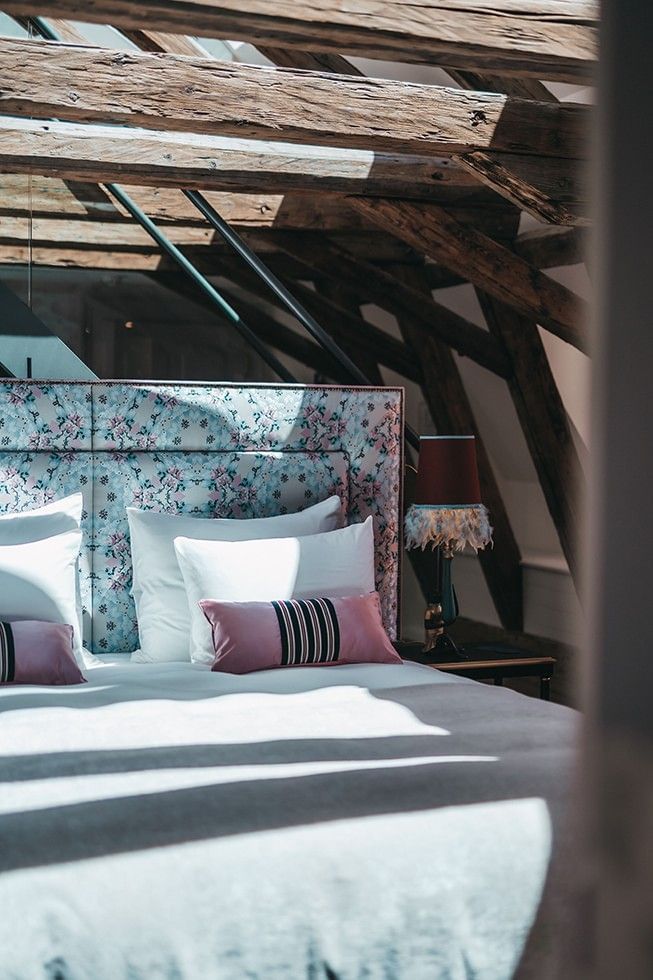
The carrier pigeon — symbol of peace, hope, and belonging — inspired the specially designed fabric for every oversized headboard. Its source: “Les Colombes”, a fabric woven for Catherine the Great in Versailles, reinterpreted by Gabriele Lenikus and produced in Austria’s Waldviertel. Leopold’s sensual “Habsburg lip” closes the head of the bed.

A gold brass palm-tree wall sconce against the subtly rolled walls of THE LEO GRAND Vienna — the delicate beige rolling pattern applied by hand is the Infanta Margarita Teresa letting her pigtails down across the landmark-protected walls
VI — The Walls

The Infanta’s
Pigtails.

A delicate beige rolling pattern on the whitewashed walls: the young Infanta Margarita Teresa lets her pigtails down. The rolling technique was chosen out of respect for old traditions — the landmark-protected walls should breathe rather than be covered. The Infanta also appears on window blinds, protecting sleeping guests from light while enjoying her own view of St Stephen’s Cathedral.

2,000 Years
in One Address.

"Over the centuries the building at Bauernmarkt 1 changed again and again — at one point a complex of houses with stables, then a magnificent city palace, now THE LEO GRAND."

~15 BC

Roman Vindobona.

Archaeological excavations beneath the building reveal artefacts from the Roman military settlement of Vindobona — forerunner of Vienna. The ground itself is a document of nearly 2,000 years.

13th–16th C.

House of the Urban Elite.

Then known as Münzerstraße — Coiner Street — the building houses Vienna's most powerful merchant families: the Franckh, Köppel, Plöyer and Prunner clans, who sat in legal judgement and shaped the early city.

1674–1703

Samuel Oppenheimer Finances an Empire.

Court factor of Emperor Leopold I, Oppenheimer lives and works at Bauernmarkt 1. He finances the defence of Vienna against the Ottoman siege of 1683 and funds campaigns against France simultaneously. At his death, the state owes him 3,500,000 Gulden.

1700–1715

Fire. Ruin. Baroque Palace.

The great fire of 1700 destroys most of the building — only the ground floor walls and basement vaults survive. New owner Schweighardt rebuilds it by 1715 as a magnificent Baroque city palace. The building we see today.

19th C.

Salons, Philosophy & Art.

The Wertheimstein and Jaques families — relatives of the philosopher Karl Popper — transform the house into a centre of Viennese intellectual life. The building's second nature: ideas over commerce.

1938–1945

A Dark Chapter.

The City of Vienna takes ownership in 1938. Many Jewish tenants disappear within weeks of the annexation — the Popper family among them. Their names are recorded in this building's history, and remembered.

2001–2011

The Lenikus Group Arrives.

Martin Lenikus acquires Bauernmarkt 1 in 2001. The building becomes home to the Lenikus Collection Art Studio Programme — nurturing a new generation of Viennese artists for a decade.

2012–2022

Ten Years of Restoration.

The most ambitious transformation in the building's history. Every Baroque detail uncovered, restored, and loved back into existence. Six metres of soil excavated. The historic roof truss preserved for posterity.

2022

THE LEO GRAND Opens.

5-Star Superior Boutique Hotel. FIABCI Silver Award. Emil Group Design Award. Prix Versailles UNESCO. The ugly duckling, as Martin Lenikus puts it, is now an elegant swan.